
What Is Robotic Knee Replacement?
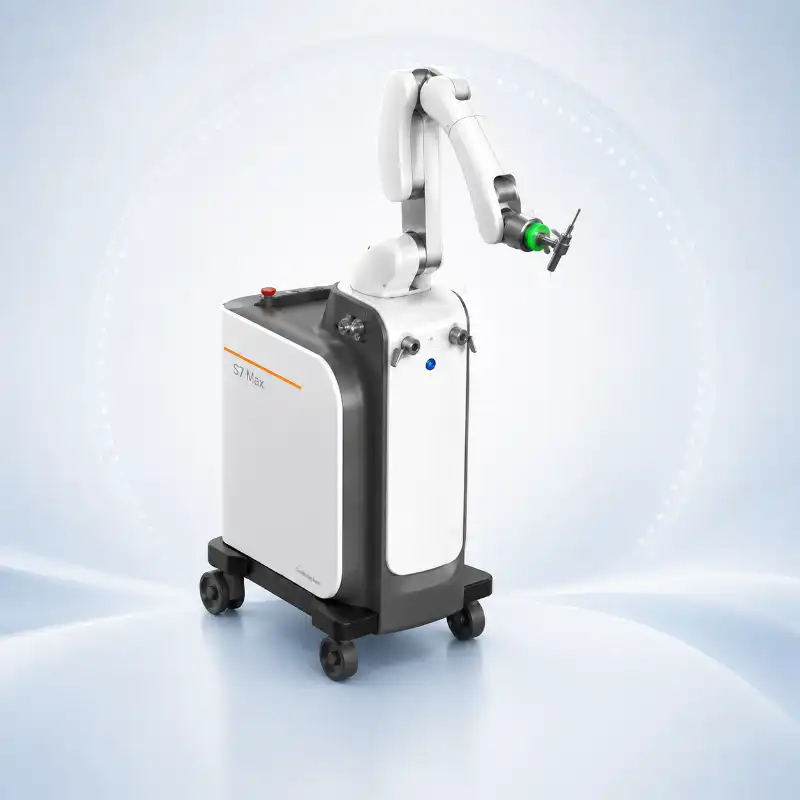
Robotic knee replacement is a total knee replacement performed with the help of a robotic arm that follows a 3D plan of your own knee, built from your scans before surgery. The surgeon still makes every decision — the robot simply executes those decisions with an accuracy the human hand cannot match, and physically stops the saw from straying outside the planned zone.
For you, that means less healthy bone removed, less soft-tissue and ligament damage, a knee that is balanced through its full range of movement, and a recovery that is usually noticeably faster in the first two weeks.
- Sub-millimetre bone cuts planned on a 3D model, not eyeballed with jigs
- Real-time ligament balancing — tension is measured, not guessed
- Less blood loss and lower transfusion requirement
- Walking within 24 hours in most patients
- Better alignment supports longer implant life
Who Should Consider Robotic Knee Replacement
Robotic assistance helps every knee, but it helps some knees a great deal more than others.
Severe bow legs or knock knees
Large deformities are exactly where manual jigs struggle and robotic planning shines. Correcting the mechanical axis accurately is the single biggest factor in a long-lasting knee.
Younger, active patients
If you are in your 50s or early 60s and expect the implant to last 20+ years, alignment accuracy matters more to you than to an 80-year-old.
Unusual anatomy or old trauma
Previous fractures, retained hardware, or an unusual bone shape make standard jigs unreliable. A 3D plan built from your own scan handles this properly.
Partial knee replacement
Unicondylar implants are extremely sensitive to positioning. Robotic assistance meaningfully improves the accuracy of partial knee surgery.
Both knees together
In bilateral surgery, consistency between the two knees matters. Robotic planning keeps both sides symmetrical.
Patients who need a fast recovery
Reduced soft-tissue trauma means less early pain, which matters if you have a heart or lung condition and need to mobilise quickly.
Robotic vs Conventional Knee Replacement
We will not oversell the robot. Here is where it genuinely helps and where the difference is small.
| Parameter | Robotic-Assisted | Conventional |
|---|---|---|
| Pre-operative planning | 3D model of your knee, cut plan finalised before surgery | Standard sizing, decisions made during surgery |
| Bone cut accuracy | Sub-millimetre, robot restricts the saw | Depends on jig placement and surgeon experience |
| Ligament balancing | Measured numerically in real time | Assessed by feel |
| Soft tissue trauma | Lower | Moderate |
| Blood loss | Usually lower | Moderate |
| Time to first walk | Typically within 24 hours | Typically 24–48 hours |
| Hospital stay | 2–3 days | 3–5 days |
| Long-term outcome at 10 years | Excellent | Excellent when alignment is accurate |
| Cost | Higher | Lower |
Comparing options? Read about total knee replacement and partial knee replacement.
How Robotic Knee Replacement Is Performed
3D planning
A CT scan or intra-operative mapping builds a digital model of your knee. Implant size, position and rotation are decided before a single cut is made.
Registration
In the OT, the surgeon maps landmarks on your actual bone so the robot knows exactly where your knee sits in space, accurate to fractions of a millimetre.
Guided resection
The robotic arm restricts the saw to the planned boundary. Damaged bone is removed; healthy bone and ligaments are protected.
Balance & implant
Ligament tension is verified through the full range of movement, then the implant is fixed and the knee tested before closing.
Surgery takes 60–90 minutes per knee under spinal anaesthesia. You feel nothing below the waist, and you are usually awake and comfortable throughout.
What to Expect After Robotic Knee Surgery
| Timeline | What you will be doing |
|---|---|
| Day 1 | Sitting up, standing and taking first steps with a walker. Physiotherapy begins. |
| Day 2–3 | Walking to the bathroom independently. Discharge home with an exercise plan. |
| Week 2 | Stitches or staples removed. Walking indoors with minimal support. Bending 90°+. |
| Week 4–6 | Walking outdoors, climbing stairs, resuming driving. Most stop the walker. |
| Month 3 | Normal daily activities, temple visits, market walks, light travel. |
| Month 6–12 | Knee feels like your own. Long walks, swimming, cycling and light gym work. |
Detailed week-by-week plan → Knee replacement recovery guide
Robotic Knee Replacement Cost in Ghaziabad
Robotic surgery costs more than conventional because of the robot, the pre-operative planning and the disposable instruments. What follows is an indicative range — you will get a written estimate for your specific case before admission.
| Procedure | Indicative Range (₹) |
|---|---|
| Robotic knee replacement — single knee | 2,20,000 – 3,20,000 |
| Robotic knee replacement — both knees | 3,80,000 – 5,50,000 |
| Robotic partial knee replacement | 1,90,000 – 2,60,000 |
| Under CGHS (empanelled) | Cashless at approved CGHS rates |
- CGHS empanelled — cashless robotic knee replacement for central government employees, pensioners and dependents
- Cashless insurance with major insurers and TPAs; our desk pre-checks your eligibility
- Written estimate before admission — no surprise additions at discharge
- EMI available on the patient share
The Robot Is Only as Good as the Surgeon Driving It
Technology does not replace judgement. Dr. Himanshu Gupta brings 20+ years and 2500+ surgeries to every robotic case.
20+ years, 2500+ surgeries
MS Orth., MCh Orth., trained at Safdarjung Sports Injury Centre, New Delhi.
One surgeon throughout
He consults, plans, operates and reviews you personally — no handover to a junior team.
Honest indications
Many patients are told to wait and given an exercise plan. Surgery is advised only when it is genuinely needed.
Rehab under one roof
In-house physiotherapy from day one, because recovery decides the result as much as the surgery does.
Robotic Knee Replacement FAQs
No. The robot never moves independently and never makes a decision. The surgeon plans the operation, holds the robotic arm and performs every step. The robot's role is to keep the saw inside the planned boundary and to give the surgeon live numerical feedback on alignment and ligament tension. Think of it as a very precise guide, not an autonomous machine.
Roughly ₹2,20,000 to ₹3,20,000 for a single knee and ₹3,80,000 to ₹5,50,000 for both knees, depending on the implant, room category and your medical condition. Amicare Hospital is CGHS empanelled, so central government employees, pensioners and dependents can have robotic knee replacement cashless at approved CGHS rates. Cashless insurance is also accepted.
It is most worth it if you have a significant deformity, unusual anatomy or previous trauma, if you are younger and want maximum implant longevity, or if you are having a partial or bilateral knee replacement. For a straightforward knee in an older patient, a well-performed conventional replacement gives excellent results at a lower cost. Dr. Gupta will tell you which category you fall into rather than pushing the more expensive option.
Most patients stand and take their first steps with a walker within 24 hours of surgery, and walk to the bathroom independently by day two. Discharge is usually on day two or three. You will walk indoors without support in about two to three weeks and resume outdoor walking and driving around six weeks.
Yes, and the reduced soft-tissue trauma and lower blood loss are often particularly helpful in elderly patients who need to mobilise quickly. Age alone is not a barrier — cardiac, pulmonary and kidney fitness is what determines safety, and that is assessed before surgery. Fit patients in their 80s are operated routinely.
Sometimes, yes. Knee implants are made of cobalt-chromium or titanium alloys and can trigger airport scanners. Carry your implant card and discharge summary when travelling and inform security staff. No special medical certificate is legally required in India, but the card makes the conversation quicker.
Modern implants last 15 to 20 years or more in most patients. Accurate alignment is one of the strongest predictors of implant survival, which is the main long-term argument for robotic assistance. Maintaining a healthy weight, avoiding repeated deep squatting and treating any infection anywhere in the body promptly all extend implant life.
Often yes, and previous surgery is sometimes a reason to prefer robotic planning because the anatomy is altered and standard jigs become unreliable. Retained plates, screws or an old fracture change how the bone must be cut. If your first knee replacement has failed, see our revision knee replacement page.
Find Out If Robotic Surgery Is Right for Your Knee
Send your standing X-ray on WhatsApp or bring it to the OPD. You will get a straight answer about which procedure suits you — including whether you can safely postpone surgery.
- Amicare HospitalPlot No. 15/16, Nyay Khand-1, Near Indirapuram Public School, Indirapuram, Ghaziabad – 201014
- Call us+91 96505 10275 · +91 98182 48928
- OPD timingsMonday to Saturday, 10:00 AM – 7:00 PM
Request a Call Back
Our coordinator will call you the same working day.
Free second opinion on your knee X-ray
No obligation, no pressure. Just an honest assessment.